Why the smell comes back
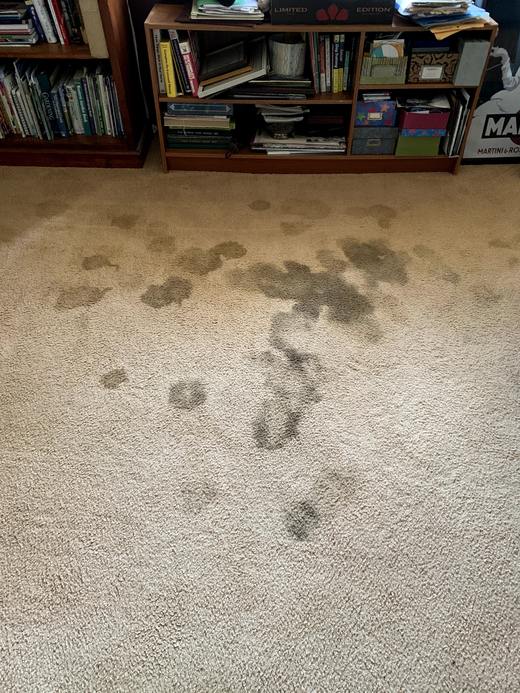
This is the part nobody explains, and it is the reason people end up paying twice. When a dog or cat has an accident, what you see on the surface is a fraction of what is actually there. Liquid hits the carpet, spreads sideways as it soaks down, and passes through into the pad — where it spreads wider still. A spot the size of a saucer on top is often the size of a dinner plate in the padding, and in bad cases it reaches the subfloor.
As it dries, urine leaves behind uric acid salts. These crystals are not water-soluble, which is the whole problem: a normal cleaning, a rented machine, or a bottle of spot remover will lift the visible stain and leave the crystals sitting in the pad completely untouched. Then the weather turns humid, the crystals draw in moisture, they reactivate, and your living room smells like it did before you paid anybody. The smell was never removed. It was just dry.
This is also why odor sprays and carpet powders make things worse over time. They add a scent on top of an active source, so you end up with the smell plus perfume, and the actual problem gets another few months to soak deeper.
What enzyme treatment actually does
Enzymes are biological — they digest the uric acid and the organic material producing the odor, and turn it into gas and water that evaporate. There is nothing left to reactivate later, because the source has been broken apart rather than covered up or diluted.
The trade-off is that enzymes need three things a quick pass cannot provide: they need to physically reach the contamination, they need dwell time to work, and they need enough volume to cover the full footprint of the spot in the padding rather than just the visible ring on top. That is why this is priced as a treatment rather than thrown in as a free spray, and why I would rather do two rooms properly than six rooms badly.
How the visit runs
- Find everything first. I inspect for spots you know about and the ones you do not. Old accidents behind furniture and along baseboards are extremely common, and treating four spots when there are seven guarantees the room still smells afterwards.
- Pre-treat and dwell. Traffic areas and stains get a pre-spray and real dwell time. Rushing this step is the single biggest difference between a cleaning that lasts and one that does not.
- Apply enzyme to the affected areas, at enough volume to reach the pad, not just the fiber. Then it sits and works.
- Hot-water extraction. Hot solution goes in under pressure and comes straight back out with the contamination. Extraction is what removes the material from the building rather than pushing it around.
- Groom and check. I re-check the treated spots before I pack up and tell you honestly what I expect over the next few days.
Drying time
Expect 4 to 6 hours with decent airflow, faster with ceiling fans or a cracked window. You can walk on it in clean socks straight away. Pets and children are fine on the carpet once it is dry — the solutions are safe at that point, which is a question I get on almost every job.
Being honest about what is fixable
Pet damage is the one service where overselling is easy and I am not going to do it. There are three levels, and where your carpet sits determines what is realistically possible:
- Surface-level — recent accidents, caught early. Cleaning and enzyme treatment resolve these almost every time, stain and smell both.
- Into the pad — repeated accidents in the same spot, or older ones. Usually a very large improvement, sometimes complete. This is where enzyme volume and dwell time earn their money, and where a second treatment is occasionally the right call.
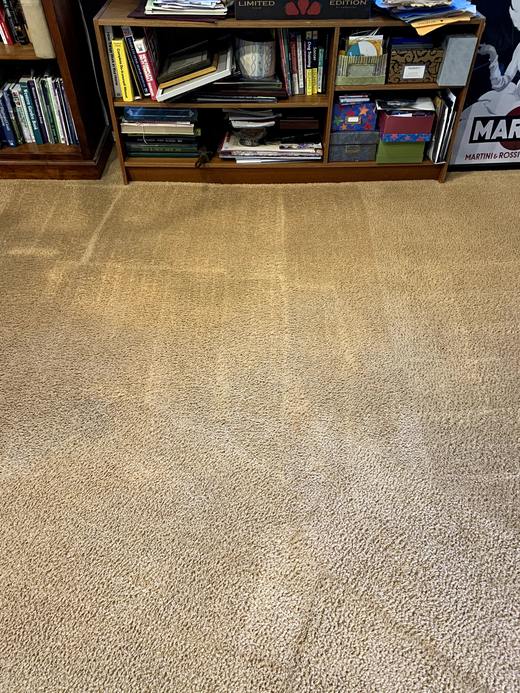
- Through to the subfloor — years of accidents in one area. No cleaning fixes this, and anyone who says otherwise is taking your money. The real repair is pulling the carpet in that area, replacing the pad, sealing the subfloor, and re-laying. I will tell you if you are in this category rather than sell you a treatment that cannot work.
Separately, some pet stains are permanent even when the odor is completely fixable. Vomit containing red dye can dye the carpet fiber the way a colorant would, and cat urine left long enough can strip color out and leave a bleached patch. In both cases the carpet has changed color rather than gotten dirty. I will point these out before I start.
14-Day Spot Guarantee. If a spot comes back within 14 days, I come back and re-treat it free. With deep pet spots, some wicking as the carpet dries is normal — material rises from the pad as moisture leaves. That is exactly what the guarantee is for. Text me a photo.
Pet treatment pricing
| Package | Price |
|---|---|
| Standard Visit — minimum service call, 1 to 2 rooms | from $189 |
| Whole Home Package Best value — 3 rooms, hallway free, deodorizer free | $299 |
| Large Home — 5 rooms, hallway, one staircase, deodorizer | $449 |
| Whole Home + Protect — 5 rooms, hallway, staircase, deodorizer, carpet protector throughout | $549 |
| Upholstery — Sofa or upholstered piece | from $125 a piece |
| Or book by the room | |
| Minimum service call | $189 |
| Per room, deep steam cleaning | $75 |
| Hallway | $35 |
| Staircase — per flight | $75 |
| Each additional room after 3 | $75 |
| Sofa or upholstered piece | from $125 |
| Area rug, cleaned on site | from $50 |
Enzyme treatment is priced per affected area, $40–75 depending on how big the spot is and how far it soaked in, and is added on top of the carpet cleaning.
The free deodorizer in the Whole Home Package is a deodorizing treatment, not enzyme treatment — they do different jobs. If you have actual pet accidents, you want the enzyme. Every job is confirmed with an exact quote before I start, so you will know the number before anything is unloaded.